



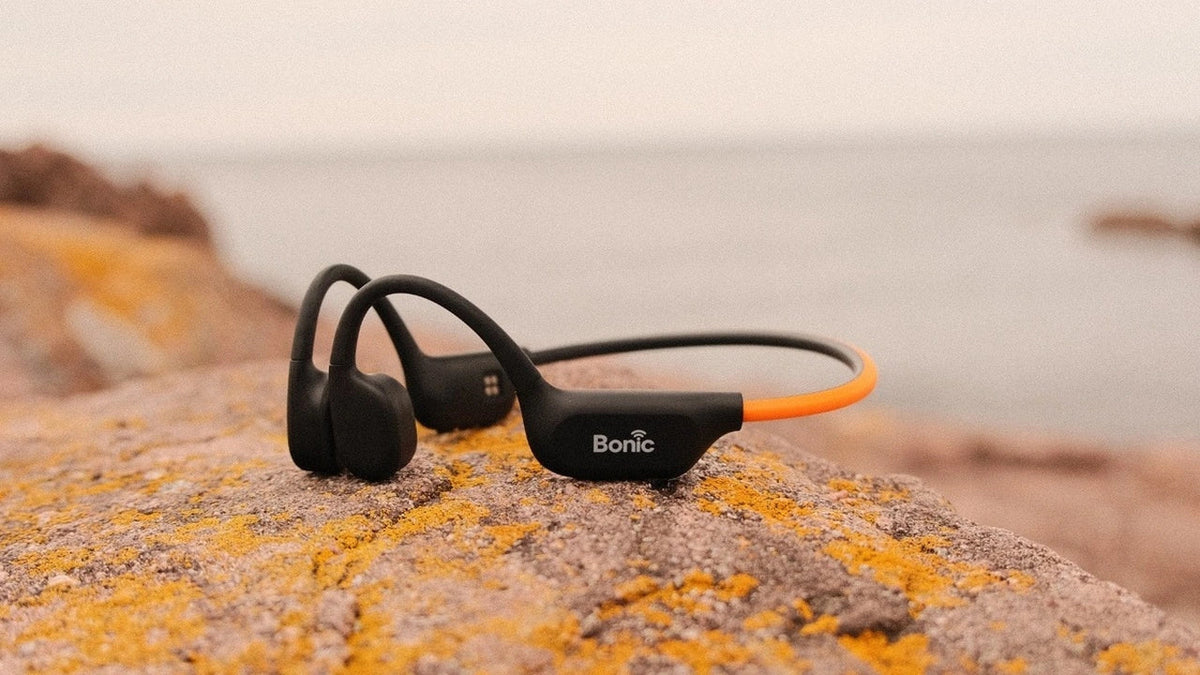
You're set for laps, you have a playlist you like, and you have a pair of bone conduction headphones in your gym bag. Do they go in the pool?
Can you swim with bone conduction headphones? Maybe, but not with all of them, or as you might when running. Three things matter: the water rating, where the music comes from if you put your head under, and whether they stay put while wearing a cap and goggles.
We've explained what each of these means for swimmers in the USA so you can tell if your headphones are built for the pool or just made for a rainy run. Are you new to this category? Check out our guide to bone conduction vs open-ear headphones.
What a Pair Needs Before It Goes in the Pool
Yes – if the pair checks three boxes.
It's rated for submersion. Look for IPX8 or IP68, and read the depth and time limits instead of focusing on the label.
It plays music without Bluetooth, thanks to internal memory built into the headphones.
It works with your swim gear; cap and goggle straps share space with the band, and they need to get along.
If you miss one, you'll either damage your headphones or swim in silence.
Why Bluetooth Stops Working Underwater
Bluetooth is a radio signal, and water absorbs radio signals quickly. Your phone and headphones can talk happily on the pool deck. Put your head under and the connection usually stutters, then drops.
It has nothing to do with the brand—it's physics—and it's the reason a pair that streams off your phone works in the shower, but is useless in the pool.
The solution is to leave your phone at home: use swim headphones. Your music will be stored on the headphones themselves, not needing a signal. Bluetooth is for when you're on dry land: calls, podcasts on the way home, whatever you want to stream before and after the swim.
"Sweat-Proof" Isn't "Swim-Proof": IPX7, IPX8 and IP68 Explained
Those codes look like alphabet soup, but they break down quickly. IP stands for ingress protection; the first number denotes dust, the second water, and an "X" means that dust wasn't rated.
|
Rating |
What it generally covers |
|---|---|
|
IPX4 |
Splashes from any direction, so sweat and light rain |
|
IPX7 |
Brief submersion, typically up to 1 meter for up to 30 minutes |
|
IPX8 |
Continuous submersion deeper than 1 meter, with the exact depth and time set by the manufacturer |
|
IP68 |
The same water protection as IPX8, plus full dust protection |
So IPX8 is enough for water, but IP68 adds dust protection, which is more important on the beach or on the trail than in the pool. You'll read that swim headphones must be IP68, but they don't need to be if the water rating is IPX8 and the headphone maker says swimming is okay.
The part most people skip is the fine print. IPX8 doesn't mean 'any depth, forever.' Each brand has its own limit, some as narrow as a couple of meters for a few hours in fresh water. Bonic lists the Cycle as up to 5 meters (16 feet), more than a typical lap pool. Check that number on the product page if you're in the USA.
Playing Music Without Bluetooth: How Onboard Storage Works
It's like putting an MP3 player inside the band. On most models, you can copy audio files to the headphone via a computer before you jump into the water, select stored music, and let it play. There's no need to bring your phone, so it stays in your locker.
There are two things you should know about storage: the only files you can play are those you have saved, so streaming apps won't play underwater. Plus, every model has its own instructions for switching modes and loading files. So read the manual in the box before you head out to the pool, not on the pool deck.
Capacity is not the problem here. Both Bonic Cycle and Bonic Fusion include 32GB of built-in memory. That's quite a few playlists, podcasts, and audiobooks to listen to in a 45-minute session.
Does Bone Conduction Sound Any Good Underwater?
Best of all, this thing works really well as it vibrates through your bones even when you're submerged. You'll hear the usual bone conduction sound: voices and podcasts are clear, and the bass is a little lighter. As mentioned in Bonic's FAQ.
You can't completely block out the sounds of the pool either, as the sounds of the pool can swamp quiet audio. Splashing, breathing, and the sound of a swimming pool fill your ears. According to Bonic's troubleshooting tips, if you put earplugs in your ears, bone conduction might sound louder, and some swimmers even wear both. The tradeoff is that earplugs rob you of some of the open-ear awareness you paid for with these.
If the sound feels low, make sure the pads are placed on your cheekbones, just in front of your ears.
Will They Stay On? Goggles, Caps and Flip Turns
Running headphones are different from swimming headphones here. Swimming moves your head differently than running. You duck under, push off the wall, do flip turns, and every move tugs at your head.
Put the band on first and make sure the pads sit on your cheekbones. Put on your cap and goggles, and check whether the straps cross the band or sit clear of it. There are different head types and gear, so there is no set sequence. Test it dry, and swim a few easy strokes before you go for a hard set.
In this case, a wraparound frame that bends to your head and springs back, like the memory metal frames on Bonic Cycle and Fusion, is a good start. It's not a guarantee against a hard push-off, so test the fit properly.
Pool, Open Water and Saltwater: What Changes
Pool. In a gym pool, your community pool, or your hotel pool in the USA, chlorine is the main thing. Just rinse the headphones in clean tap water after every swim, wipe them down, and let them air dry. According to Bonic, rinsing is fine for both models.
Open water. A lake or river brings colder water, wave noise, and sometimes boats. Open-ear sound helps you hear what's around you, but it's not a safety mechanism. Don't swim alone. Turn the sound volume down so you can hear everyone. Check the rules before you wear headphones at an event, as many have their own rules.
Saltwater swims are more challenging. Bonic says to avoid long saltwater swims and hot tubs and saunas, as salt can wear on speaker mesh and sound. A quick dip and rinse in fresh water is different from a long ocean swim. Keep sea swims short and rinse right after.
Whatever the water, you'll need to make sure your charging port is completely dry before plugging it in.
Bone Conduction vs Waterproof Earbuds for Swimming
Waterproof in-ear earbuds can also work in the pool, so why should you opt for bone conduction? The answer is largely one of fit and awareness.
In-ear buds seal the canal, which gives them an edge on bass and keeps pool noise out, but also shuts out the coach, the lane rope rattling next to you, and the swimmer behind you. A tip that's slightly off can work loose mid-set, and once water gets into the ear, it can muffle everything. Bone conduction bypasses the canal altogether, and that's why many swimmers use it for long, steady sessions.
Neither is necessarily better. For fuller sound and if you don't mind being cut off, sealed earbuds might work for you. If you'd rather hear what's happening around you, open-ear bone conduction may work better for you.
A Simple Routine for Your First Swim
New gear tends to fail at the worst possible moment, so do the boring checks at home first.
Charge them fully and make sure the port is dry afterward. Load a playlist, turn it on to stored-music mode, and make sure it starts playing without your phone near. Wear them with your cap and goggles on dry ground for a few minutes, and then take your first easy swim. Once you're done, give them a good wash with some fresh water, wipe them dry, and let them air out before putting them back in the bag.
It only takes a few minutes and saves you from finding out mid-lane that you forgot to change modes.
How to Choose Swim Headphones
Before you buy swim headphones in the USA, stop listening to the marketing for a second and read these four checks.
The water rating, with numbers such as IPX8 or IP68, plus the depth and time. A rating that has no limits listed should be a question to the brand.
Storage to fit how you listen. If you like podcasts and audiobooks, you'll need more space than someone with one playlist.
Controls you can use when wet. Physical buttons are easier to find under a cap than touch surfaces.
Battery life for your longest session. Bonic lists 7 to 9 hours on one charge, which is plenty for a long open-water morning.
Which Bonic Pair Makes Sense for the Pool?
You're planning a swim-friendly setup, but still looking for the Best Bone Conduction Headphones in the USA? Bonic has two models with the same water specs: water protection IPX8, 32GB of memory onboard for phone-free playlists, and a bendable memory metal body. Bonic also recommends both for swimming, not just land workouts.
Weight and one light separate them. The Bonic Cycle weighs 31g, is rated for submersion up to 5 meters (16 feet) in water, and is equipped with a rear LED. That won't matter much in a lane, but it'll earn its keep if you take the headphones out with you just before sunrise or just after dark. The Bonic Fusion comes stripped of the light, weighs 27 grams, and comes in four different colors. If you primarily swim and train in the daylight, it might be the lighter option.
Still undecided? Compare Bonic Cycle and Fusion on our comparison page. You'll have a chance to try either one risk-free for 90 days.
Final Verdict
So, can you swim with bone conduction headphones? Sure, if you pick a pair made for the water and treat the pool as its own setup. Check the rating of the headphones, load the music before you enter the pool, and test how they fit before you go in.
Shop Bonic Cycle and Fusion to find the right pair for the pool and dry land. Standard shipping within the USA takes 3-5 business days, and you have a 90-day trial period to test them in the pool.
FAQs
1. Can you swim with regular bone conduction headphones?
No, unless they're rated for submersion. Many running models are only built to handle sweat and splashes and won't work in a pool. Check for IPX8 or IP68 and look for a depth and time limit.
2. Does Bluetooth work underwater?
No, the radio signal is lost once you're submerged. Use music stored on your headphones while swimming. Use Bluetooth on dry land.
3. Is IPX8 enough for swimming?
Yes, for the water rating, IPX8 covers continuous submersion above 1 meter; each manufacturer has its own depth and time limits. IP68 adds dust protection but doesn't change the water rating.
4. What about wearing them with goggles and a swim cap?
Usually, but it depends on your head shape and gear. Test the fit dry and on a few easy lengths before doing a hard set, and make sure the goggle strap isn't pushing the band out of place.
5. Do I need to rinse them after swimming?
Yes, just rinse your headphones with fresh water after use in the pool or open water, pat dry, and be sure that you have completely dried the charging port before plugging them in.
Share:
Bone Conduction vs Open-Ear Headphones: Which Is Better?
Are Bone Conduction Headphones Safe? The Myths vs. The Facts