



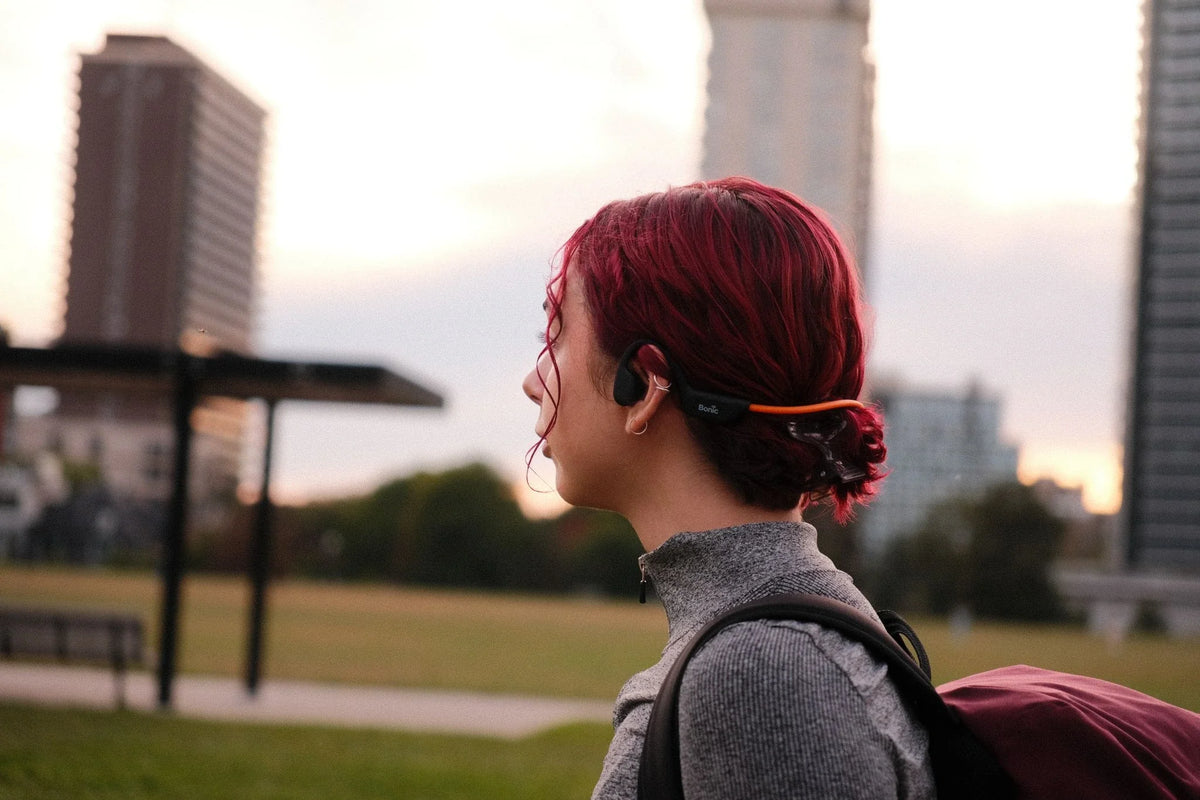
Are bone conduction headphones safe to use? Most people can use bone conduction headphones safely, at a moderate volume and with frequent breaks. Even though they are open-ear, the sound still reaches the inner ear, so long, loud use can be harmful to your hearing. The way you listen is more important than what you wear.
This last bit is what most buying guides skim over, telling you that the open design keeps you aware of traffic and calling it a day. Fair enough, but that's only half the story. The other half is volume, time, and a handful of myths that keep floating around forums and product pages. So let's go through them one at a time.
How Do Bone Conduction Headphones Work?
Regular headphones push sound through the air. The sound travels down your ear canal, bounces against your eardrum, and then travels to the tiny bones in your middle ear before reaching the cochlea, that snail-shaped organ in your inner ear that turns motion into nerve signals.
Bone conduction avoids the first half of that journey. Small transducers rest on your cheekbones just in front of your ears and turn the audio into vibrations that travel through bone to the cochlea. No bud in the canal. No cup over the ear.
Here's the thing to remember: The cochlea is still doing the work. Your inner ear is involved either way. I don't think the idea that bone conduction somehow gets around your hearing system is true. It only gets around part of the way and not to the destination. Nearly everything below hangs on it. Open-ear headphones that use air to convey sound to your ears, the kind that hover near your ear and aim sound into it, come with their own trade-offs.
Are Bone Conduction Headphones Safe for Your Hearing?

Hearing damage comes down to two things: how loud and how long it lasted. Loud for a short time can hurt. Moderately loud for a very long time can hurt as well. And the damage is sneaky. It builds up slowly, doesn't hurt, and by the time you notice, most of it is done.
An open ear canal doesn't change the math. It changes what you can hear around you, which is an added benefit. The music you hear comes through a bud, a cup, or a cheekbone, and your cochlea does the same.
So what is a reasonable ceiling? There are two places to get this information that are not measuring the same thing.
The National Institute for Occupational Safety and Health (NIOSH), at the CDC in the USA, recommends that noise levels in the workplace should be kept below 85 A-weighted decibels (dBA) over a period of eight hours, and that time intervals should be cut in half with every 3 dB increase. That's good advice for workers, not a rule for your headphones. NIOSH does report that protection of your hearing when noise is 85 dBA or higher is good practice anywhere, so it's a useful yardstick.
|
Sound level (NIOSH) |
Time before you reach the daily limit |
|
85 dBA |
8 hours |
|
88 dBA |
4 hours |
|
91 dBA |
2 hours |
|
94 dBA |
1 hour |
|
97 dBA |
30 minutes |
|
100 dBA |
15 minutes |
A second source can help us out. This is the WHO-ITU safe listening standard for personal audio devices: 80 dB per 40 hours per week for adults, and 75 dB for children.
5 Common Myths About Bone Conduction Headphones
These are the five myths people commonly raise when asked if bone conduction headphones are safe to wear. Short answers first.
Myth 1: Bone Conduction Headphones Can't Damage Your Hearing
They can. The vibrations can go up into your cochlea, and the same exposure rules apply. The open-ear design of the headphone has no volume limiter; if you crank it up and leave it there, your ears will pay the price.
Myth 2: They Send Sound Only Through Your Bones
The path is way more muddled and messy than the marketing makes it sound. Testing groups like RTINGS have found that consumer bone conduction headphones work on the outer and middle ear too, and some of the sound leaks into the air. Ever notice the person next to you who hears your podcast at high volume? That's the leak.
Myth 3: Open Ears Mean You'll Hear Everything Around You
Sure, you'll hear more than you would with sealed buds, but music still competes for your attention. A loud track, a gripping podcast, a quiet e-bike creeping up behind you. Being aware isn't automatic. States have different rules on wearing headphones while driving or riding. Check your state's restrictions.
Myth 4: They Cause Headaches or Brain Damage
The good news is that there is no solid evidence yet to indicate that bone conduction headphones may harm the brain. Headaches may be less clear-cut. Sure, any headphones can make you uncomfortable if the fit squeezes your temples for hours. But pressure, an itchy buzz on the cheek, and general fatigue around the face are probably the most common bone conduction headphone side effects. It's probably something about the fit or the volume, so try another position or lower the volume, and if you continue having headaches, stop using them and see your doctor.
Myth 5: They're Right for Everyone
Not always. Your ears, your hearing history, and your comfort also play a role. Someone with tinnitus or recent changes in their hearing will need different advice than a runner with healthy ears. A fit that works for one head might be like a clamp for another. And what works for a friend may not work for you. More on who should be careful in a minute.
Can Bone Conduction Headphones Cause Hearing Loss?
Any headphones can, provided you play them loud enough. That part is the science about noise exposure in general. The other piece, though, is research on the long-term hearing effects of consumer bone conduction headphones. I haven't found any solid long-term studies showing these to be safer or less dangerous than other headphones at the same volume. Anyone who says otherwise is either guessing or selling something.
So, do bone conduction headphones damage hearing? Well, not so much the technology, but the dose. Volume multiplied by hours.
-
Know the warning signs:
-
Ringing or buzzing after you've been listening.
-
Sounds that are muffled or dull.
-
Uncomfortable or full feeling in your ears.
-
Needing the volume higher than you used to.
If any of those fail to go away or keep coming back, see a doctor or audiologist. Don't just wait it out.
How to Use Bone Conduction Headphones More Safely
This stuff is simple. A few habits cover most of it.
-
Start low, only go up if you have to. Start at a low level and gently drag it up until the sound is clear. Then stop.
-
Don't crank it up to beat traffic, a packed gym, or a windy trail. Turn it down. Choose a quieter route or time, or accept that some places are just not music-friendly.
-
Give your ears a break. Pause the audio now and then. Silence is free.
-
Use the tools on your phone. Headphone safety alerts and listening reports exist for a reason.
-
To make them fit properly, follow the instructions of your maker. Too tight a fit will land you with sore cheeks very quickly.
-
Stay alert. Keep the volume down at pedestrian crossings and paths shared by others, and remember that the local rules may be different.
Who Should Be Careful When Using Bone Conduction Headphones?

Some people should think twice, or at least check with a professional first:
-
People with tinnitus, or ringing that comes and goes.
-
Those who have hearing loss or recent changes in hearing.
-
People with ear pain or ear or skull conditions.
-
Parents choosing headphones for children, as WHO-ITU standards use a lower reference level for kids.
An article on general health issues can't tell you what's right for your ears. An audiologist or doctor can.
Putting Safety First: What to Look for in Your Next Headphones
Now that you know the danger is in how you listen, shopping becomes simpler. Skip the slogans and look for the practical. Does it stay comfortable for the hours you'll wear it? Is it easy to change the volume? Does it fit in the location where you'll be wearing it?
If you want one of the best bone conduction headphones in the USA for outdoor use, the Bonic Cycle is one to look at. It weighs 31g, has a built-in rear LED safety light with different modes, and is IPX8-rated. The Bonic Fusion is lighter at 27g and does not have any LED, so it works well in daytime or in well-lit areas. Both are open-ear and silicone-built. Compare the specs with your routine, not ours.
Conclusion
So, are bone conduction headphones safe? Most of the time, yes; just treat them as other headphones: set the volume right, rest your ears, and notice when you can feel something different. The open-ear design helps you be more aware, whether you're running a trail or walking in city traffic anywhere in the USA. It doesn't create a force field around your hearing.
If you'd like to find out more about how the headphones can be used for everyday ear care, check out Bone Conduction Headphones: Ear Safety & Benefits. If you're shopping for bone conduction headphones in the USA, use the information you learned here to better help you listen.
FAQs
1. Are Bone Conduction Headphones Safe for Everyday Use?
For most people, yes, as long as you don't play them too loud and take frequent breaks. Everyday use is not the problem - long, loud sessions are. Pay attention to how your ears feel after you listen, and if anything seems off, check in with a hearing professional.
2. Are Bone Conduction Headphones Safer Than Earbuds?
Not automatically, but they leave the ear canal open, allowing you to hear, and nothing stays in your ear. The risk of hearing loss depends on the level of volume and time you listen, whatever type of headphones you wear. Neither is safe at high volume for hours, so be careful with the loudness.
3. Can Bone Conduction Headphones Cause Hearing Loss?
Yes, they can if you listen too loudly for too long. Sound still gets to your inner ear. It's not the technology causing it; it's the way you're exposed. Long-term studies of this kind of headphones are few, so be sensible about the volume and take frequent breaks.
4. Can You Wear Bone Conduction Headphones All Day?
Some people do, but it adds up. The number of hours you spend listening counts towards your weekly sound exposure, and wear pressure can build up around the cheeks and temples. Turn down the volume, pause the audio now and then, and take the headphones off when something feels uncomfortable.
5. Should People With Tinnitus Use Bone Conduction Headphones?
No one knows for sure. Louder listening may worsen symptoms for some. Talk to your audiologist or doctor if you feel you are having ringing or your hearing is changing.
Share:
Can You Swim With Bone Conduction Headphones? Bluetooth, MP3 & IPX8 Explained