



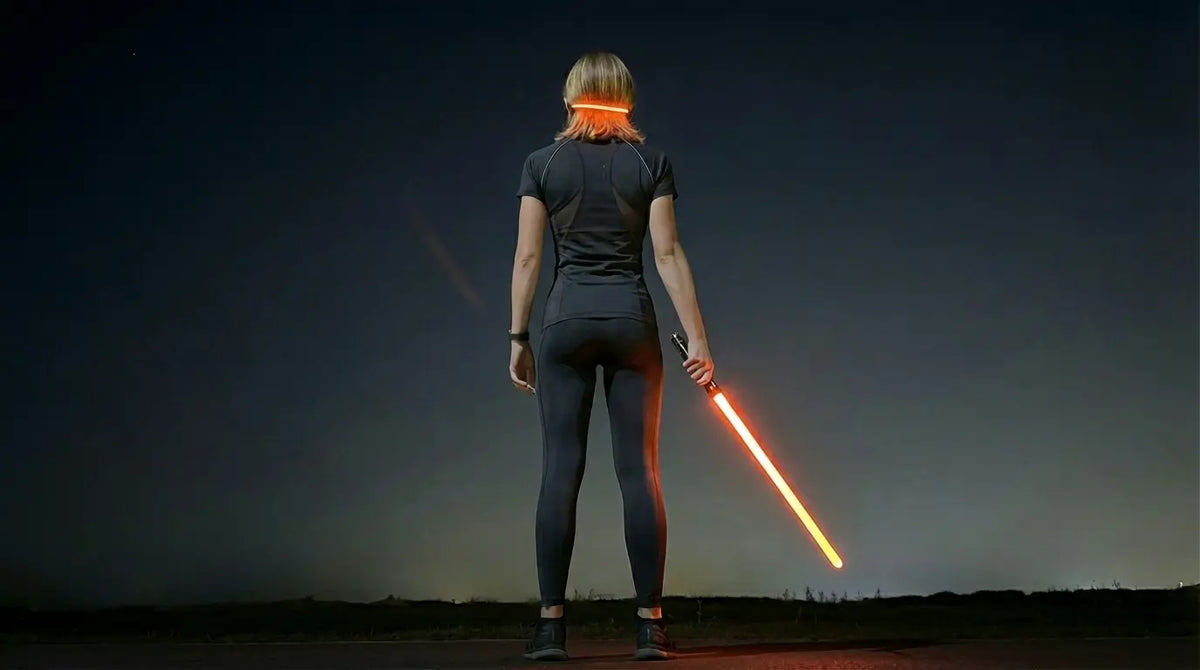
When LED running gear first started appearing on the market, it had a novelty problem. The products looked like something a cyclist might strap to a commuter bike, they required separate batteries, they clipped on awkwardly, and they felt like an optional add-on for runners who took safety a little too seriously.
That perception has changed — slowly at first, and then decisively, as the research on pedestrian visibility has become harder to ignore and the gear itself has caught up with what runners actually need.
So: is LED running gear a genuine safety investment, or is it solving a problem that doesn't really exist? Here's what the evidence actually shows.

The Problem That LED Gear Is Designed to Solve
To evaluate whether a solution works, you have to be precise about the problem it's solving. In this case, the problem isn't darkness — it's detection distance.
When a vehicle is traveling at 35 miles per hour, it covers approximately 51 feet per second. The distance at which a driver must detect a pedestrian to have time to react and brake safely is typically cited in driver behavior research at around 200 feet. At higher speeds, that distance increases. At 45 mph, you need roughly 300 feet of visibility to safely stop in response to a pedestrian crossing your path.
Research from the National Highway Traffic Safety Administration documents that pedestrian fatalities are disproportionately concentrated at night — in conditions where detection distance is severely compressed for unlit pedestrians. The most common contributing factor in nighttime pedestrian fatalities is not driver inattention or impairment: it's that the pedestrian was not visible in time for the driver to respond.
It takes a driver at 35 mph more than 100 feet to react and stop. If you're only visible at 50 feet, the physics don't allow for a safe outcome — regardless of how attentive the driver is.
What the Research Says About Passive vs. Active Visibility
This is where the distinction between reflective gear and active LED lighting becomes critical — and where the gimmick narrative falls apart.
Reflective Material: What It Actually Does
Reflective strips, vests, and patches work by bouncing light back toward its source. When a car's headlights hit a reflective strip on a runner's clothing, some of that light returns to the driver's eyes. In ideal conditions — a driver looking directly ahead, headlights on, at a distance close enough for the returned light to be sufficient — reflective material works reasonably well.
The problem is that road encounters between runners and vehicles are rarely ideal. Vehicles approach at angles. Street lighting changes the contrast conditions that reflective material depends on. Bright urban environments with multiple competing light sources can reduce the salience of a small reflective patch significantly. And reflective strips offer no protection against vehicles whose headlights are not directly pointed at the runner — cyclists, right-turn vehicles, vehicles pulling out of side streets.
Research published in the journal Injury Prevention, examining pedestrian visibility in real-world traffic conditions, found that passive reflective materials showed substantial performance variation depending on approach angle and ambient lighting — and that the variation was large enough to matter for safety outcomes.
Active LED: What Changes
Active LED lighting generates its own light signal. It does not depend on an external light source to be detected — it is independently visible in all ambient lighting conditions, from multiple angles, and at greater distances.
The relevant performance metric for running safety isn't peak reflectivity — it's reliable detection distance across the range of real-world conditions a runner will actually encounter. Active lighting consistently outperforms passive reflectivity on this metric, particularly in the angled and ambient-light scenarios that are most commonly present in suburban and urban running environments.
Additionally, human visual processing has a well-documented sensitivity to biological motion — the pattern of moving lights associated with a human body in motion. Research from vision science demonstrates that observers can detect and identify a moving human figure from significantly greater distances when light sources are placed at joint positions (head, torso, limbs) than when uniform lighting or reflective strips are used. This biological motion signal is something LED gear at head height and torso naturally activates.
The Objections — and What They Get Wrong
The skepticism around LED running gear usually comes in a few predictable forms. It's worth addressing each directly.
"I run on quiet streets. I don't need it."
Pedestrian incidents with vehicles are documented on streets of all types — including residential streets, cul-de-sacs, and driveways. The assumption that quiet streets are safe streets misunderstands the risk profile: low-traffic environments produce fewer incidents overall, but the per-incident risk of driver non-detection is similar, because the driver has the same visual limitations regardless of road type. The difference is that on a quiet street, there are fewer vehicles — not that the vehicles that are present can see you any better.
"I wear a reflective vest. That's enough."
It may be — in ideal conditions. The research suggests that the gap between reflective performance and active LED performance is most significant precisely in the conditions where running risk is highest: angled approaches, partially lit environments, and situations where the driver's attention is divided. The question isn't whether reflective gear provides some protection — it's whether it provides consistent protection across the full range of scenarios a night runner will encounter over hundreds of runs.
"It's too much extra gear to bother with."
This objection identified a real problem with early LED running products, which required separate charging, clipping on, or maintaining as additional equipment. The evolution of the category has been toward integration — building LED visibility into gear the runner is already wearing, most logically the headphones, so that there's no separate activation step, no extra battery to charge, and no possibility of leaving the house without it.
When visibility is built into a piece of gear you're wearing anyway, the friction argument disappears. You don't decide whether to turn it on. It's on.
The Visibility Angle Problem
One underappreciated nuance in LED running gear is that coverage angle matters as much as brightness.
A single front-facing light on a running vest protects against oncoming traffic but offers minimal visibility to vehicles approaching from behind, from the side, or at intersections. A single rear light reverses that exposure profile. For real-world night running — which involves direction changes, intersections, driveways, and vehicles approaching from all angles — the relevant standard is multi-directional visibility.
Research on traffic safety consistently recommends that pedestrian visibility systems cover the full 270-degree arc of relevant approach angles. This means front, rear, and lateral — the full perimeter of directions from which a vehicle encounter could occur.
A front-facing light protects you from what you can see coming. A 270-degree system protects you from everything you can't.
The Integration Question: Where LED Belongs
The most practical argument for integrated LED lighting — built into the gear you're already wearing rather than added as a separate accessory — is behavioral.
Runners are consistent in some ways and inconsistent in others. Training schedules, routes, paces — these tend to be disciplined. Pre-run gear setup, particularly for optional accessories, is where corners get cut. The clip-on light that requires finding in a drawer, charging, and attaching is the one that stays home on a cold Tuesday in November when you're running late.
LED that lives in your headphones has a different behavioral profile. You're already putting your headphones on. The light is already there. There's no additional decision — and no run where you're unprotected because you forgot the extra step.
This is why the integration model isn't just more convenient. For most runners, over a full year of training, it's the difference between consistent visibility and occasional visibility. And occasional visibility, as the physics of driver reaction time make clear, isn't the same thing as safety.
So: Gimmick or Game-Changer?
LED running gear started out with a gimmick reputation, and the early products earned it. Fragile clip-ons, forward-only visibility, awkward designs that looked like cycling accessories poorly adapted for running — these were real problems.
The gear has changed. The research hasn't — visibility has always been the primary variable in nighttime pedestrian safety, and active lighting has always outperformed passive reflectivity in the conditions that matter most. What's changed is that the products now reflect the science: integrated, multi-angle, waterproof, and built for the runner who runs every night, not just the nights they feel like being careful.
That's not a gimmick. That's what it looks like when a category finally takes the problem seriously.
Run Visible Every Night → Shop Bonic LED Open-Ear Headphones at bonictrack.com
References
National Highway Traffic Safety Administration. (2023). Pedestrian safety. U.S. Department of Transportation. https://www.nhtsa.gov/road-safety/pedestrian-safety
Injury Prevention. (2019). Passive vs. active visibility in pedestrian safety: Real-world performance of reflective and LED-based systems. BMJ Publishing Group. https://injuryprevention.bmj.com
Tyrrell, R. A., Wood, J. M., Chaparro, A., Carberry, T. P., Chu, B.-S., & Marszalek, R. P. (2009). Seeing pedestrians at night: Visual clutter does not mask biological motion. Accident Analysis & Prevention, 41(3), 506–512. https://doi.org/10.1016/j.aap.2009.01.012
Johansson, G. (1973). Visual perception of biological motion and a model for its analysis. Perception & Psychophysics, 14(2), 201–211. https://doi.org/10.3758/BF03212378
ScienceDirect. (2021). Driver reaction time and pedestrian detection in low-light environments. Elsevier. https://www.sciencedirect.com
Share:
Why Open-Ear Headphones Are Taking Over the Running World
Is It Safe to Run at Night? What the Research Actually Says