



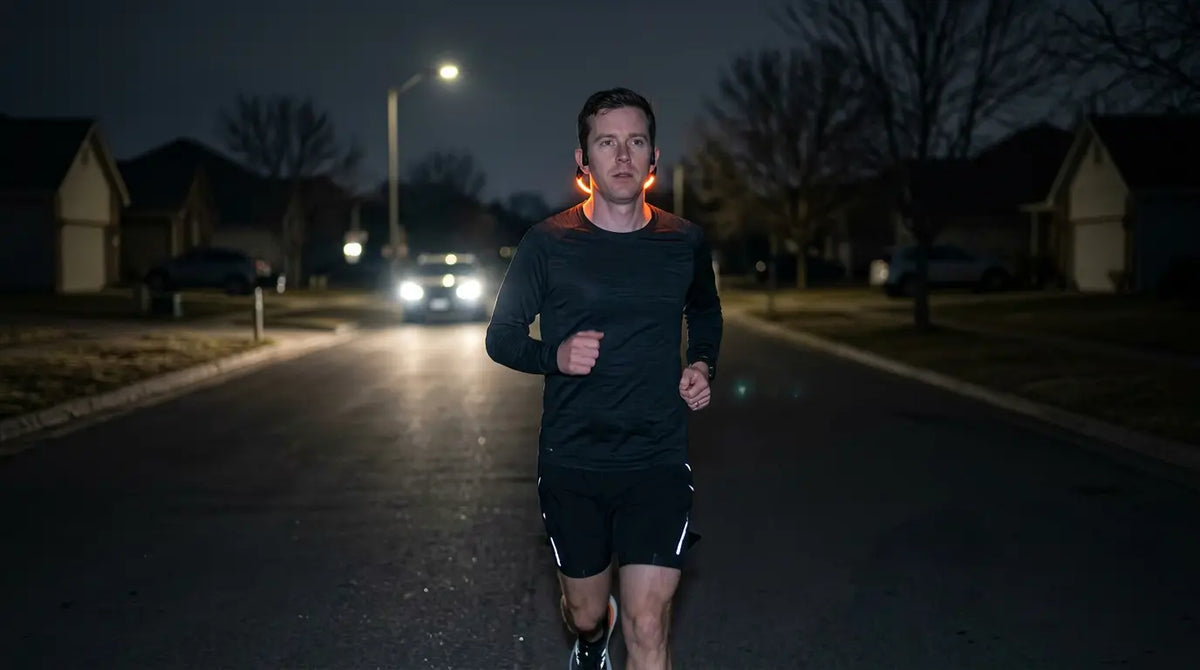
It's 7:30pm. Dinner is done, the kids are settled, and this is the only hour that belongs to you. You lace up and head out — the streets are quieter now, the air a little cooler, the neighborhood finally still.
If you're a working parent who runs after dark, you know this feeling. You also know, somewhere in the back of your mind, that running at night is different. The question is: how different — and what actually matters when it comes to staying safe?
The research on night running safety is more specific than most people realize. Here's what it actually says.

The Real Risk Is Being Unseen
The most significant documented danger of running at night isn't fatigue or tripping on uneven pavement. It's visibility — specifically, the failure of drivers to detect pedestrians in low-light conditions before it's too late to react.
According to data published by the National Highway Traffic Safety Administration, pedestrian fatalities are disproportionately concentrated in nighttime hours. Despite lower overall traffic volume, the majority of pedestrian deaths occur after dark — and a recurring factor is inadequate visibility at the point of conflict between pedestrian and vehicle.
The implication isn't that you shouldn't run at night. The data is more specific than that: it's that runners without active visibility measures are at materially higher risk than those with them.
The difference between a runner being seen and not being seen can come down to a single second of driver reaction time — and whether you're visible from 50 feet or 200 feet changes that equation entirely.
What 'Visible Enough' Actually Means
Reflective strips have long been the default recommendation for night runners. But research published in the journal Injury Prevention draws an important distinction: passive reflectivity (material that reflects light back to its source) performs very differently from active lighting (a light source that emits its own signal).
Reflective materials depend entirely on the angle and intensity of an incoming light source — meaning they work when a car's headlights are pointed directly at you, but offer little protection from vehicles approaching at angles, from cyclists, or in poorly lit urban environments.
Active LED systems, by contrast, generate their own light signal that is detectable across a wider range of angles and at greater distances — which is why the shift among serious night runners has been toward wearable lighting, not just reflective material.
The Second Risk: Hearing Loss of Situational Awareness
The second most cited contributor to pedestrian-vehicle incidents at night isn't darkness itself — it's the combination of reduced visibility and reduced auditory awareness. When a runner can't see as well and can't hear traffic approaching, the margin for error narrows to almost nothing.
This is where the type of headphones a runner wears becomes a safety variable, not just a comfort preference.
In-ear headphones that seal the ear canal effectively block the ambient sound environment. That means traffic from behind, a cyclist calling out, a car reversing out of a driveway — all of it is filtered out or significantly reduced. For a daytime park run, this might be an acceptable tradeoff. For a solo nighttime road run, it changes your risk profile in ways that are difficult to compensate for.
Open-Ear Design as a Safety Architecture
The case for open-ear audio during night running isn't primarily about sound quality — it's about maintaining the situational awareness that darkness has already partially taken from you. If your eyes are working at 60% of their normal effectiveness after dark, the last thing you want is to voluntarily cut your hearing to the same level.
Open-ear designs, which sit outside the canal rather than inside it, allow ambient sound to pass through naturally alongside your audio. You hear your music and the world around you simultaneously. Research on auditory situational awareness consistently shows that preserving background sound perception is a meaningful safety mechanism for pedestrians operating in mixed-traffic environments.
Night Running Is Statistically Safer With the Right Setup
None of this is an argument against running at night. Millions of people do it safely every day — including those who run exclusively after dark because it's the only time available to them. The research doesn't say don't run at night. It says: what you wear matters.
The factors that most meaningfully affect night running safety, based on the available evidence:
• Active LED visibility — generating your own light signal rather than relying on passive reflectivity
• Visible from multiple angles — not just front and back, but from the sides, where vehicle approach angles most commonly occur
• Preserved auditory awareness — using audio that lets you hear your environment rather than sealing it out
• Consistent use — gear that's simple enough to use every single time, not just on nights when you remember to clip something extra on
The last point matters more than it gets credit for. A visibility system that lives on your headphones is one you'll actually use on Tuesday night in the rain. A clip-on light that requires separate batteries and a spare hand to attach is one you'll skip.
What This Means for Runners Over 35
If you're in your mid-thirties or beyond, running after dark typically isn't a recreational choice — it's the only option. Work, family, and the reality of a full schedule mean the 7:30pm slot is your training window, and you've accepted that.
What the research suggests is that this window doesn't have to come with meaningfully higher risk, as long as the right infrastructure is in place. The runners who are most at risk after dark are those who haven't updated their gear to match the conditions they're actually running in.
A headphone built for a gym session or a Sunday morning park run isn't the same as one designed for a solo road run at 9pm on a Wednesday. The standards are different — and so should the gear be.
Running at night is not the problem. Running at night without the right visibility and awareness tools is where risk concentrates.
The Bottom Line
Night running is safe when you treat it with the seriousness it deserves. The research is clear on what moves the needle: active lighting that works from multiple angles, and audio that preserves your ability to hear the environment you're moving through.
Everything else — pace, route, distance — is secondary. The runners who log consistent miles after dark for years aren't lucky. They're equipped.
Built for the Night Run → Shop Bonic Open-Ear LED Headphones at bonictrack.com
References
National Highway Traffic Safety Administration. (2023). Pedestrian safety. U.S. Department of Transportation. https://www.nhtsa.gov/road-safety/pedestrian-safety
Tyrrell, R. A., Wood, J. M., Chaparro, A., Carberry, T. P., Chu, B.-S., & Marszalek, R. P. (2009). Seeing pedestrians at night: Visual clutter does not mask biological motion. Accident Analysis & Prevention, 41(3), 506–512. https://doi.org/10.1016/j.aap.2009.01.012
Owens, D. A., & Tyrrell, R. A. (1999). Effects of luminance, blur, and age on nighttime visual guidance: A test of the selective degradation hypothesis. Journal of Experimental Psychology: Applied, 5(2), 115–128.
Injury Prevention. (2019). Pedestrian visibility and active lighting at night: Implications for road safety. BMJ Publishing Group. https://injuryprevention.bmj.com
ScienceDirect. (2020). Ambient sound perception and pedestrian safety in urban environments. Elsevier. https://www.sciencedirect.com
Share:
LED Running Gear: Gimmick or Game-Changer?
Bone Conduction vs Open-Ear Headphones: Which Is Better?